Japan Earthquake Live: 7.7 Magnitude Hits Sanriku Coast | Megaquake Alert
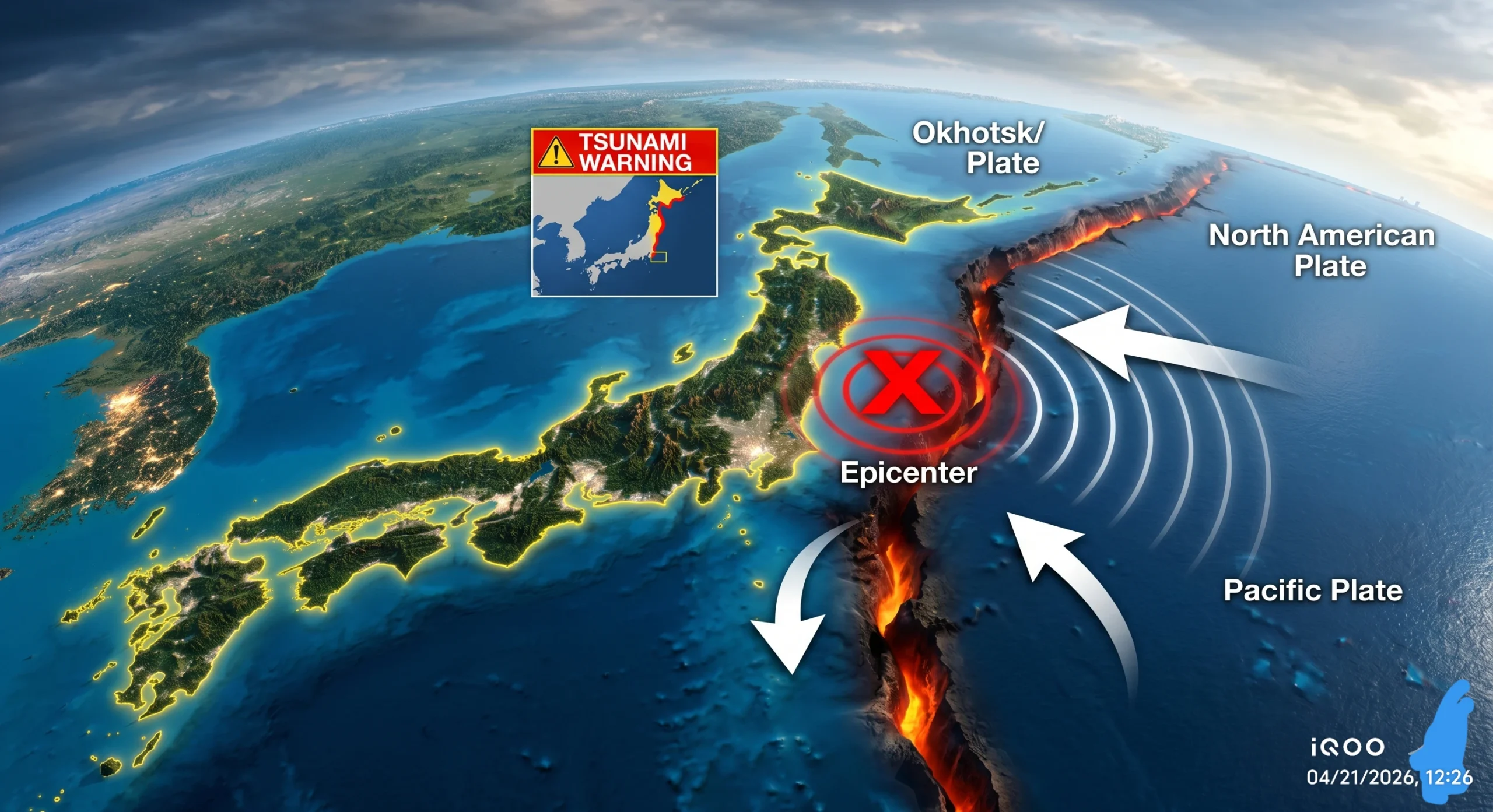
The ground beneath Japan has always been restless, but the events of April 20, 2026, have reignited a deep-seated fear across the archipelago. At precisely 4:53 p.m. local time, a massive 7.7-magnitude earthquake struck off the northeastern coast of Honshu, centered in the Pacific waters near the Sanriku region. This event, now being referred to as the 2026 Sanriku Earthquake, has placed the nation on high alert, not just for the immediate damage, but for what scientists warn could be a precursor to something much larger.
The Moment the Ground Moved: April 20, 2026
The earthquake’s epicenter was located approximately 100 kilometers east of Miyako in Iwate Prefecture, at a shallow depth of just 19 kilometers. For the residents of the Tohoku and Hokkaido regions, the shaking was violent and prolonged. In Aomori Prefecture, specifically in the town of Hashikami, the seismic intensity reached Upper 5 on the Japanese Shindo scale—a level where walking becomes difficult without holding onto something and unreinforced walls are prone to collapse.
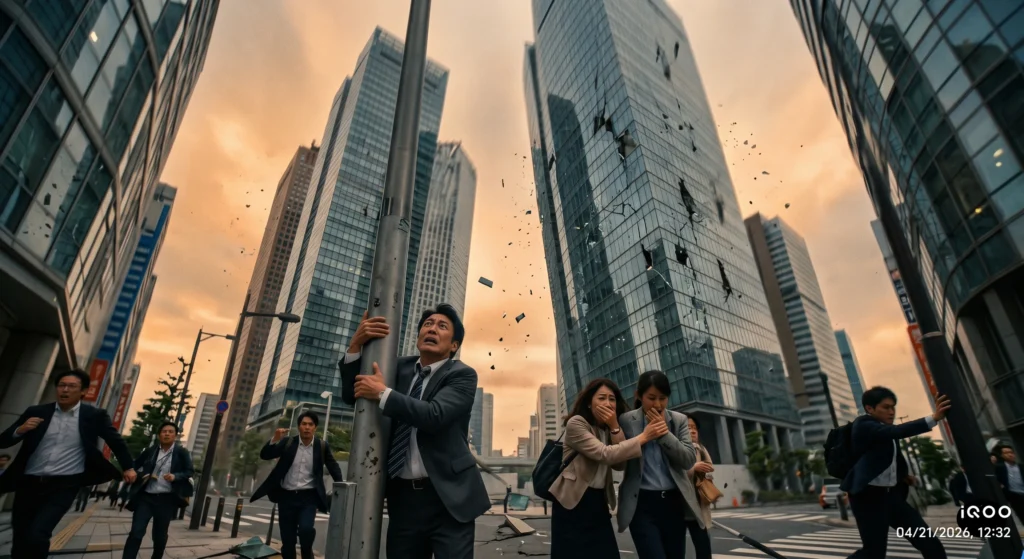
The tremors were so powerful that they were felt hundreds of kilometers away in Tokyo, where high-rise office buildings swayed for over a minute, sending a chill through the capital’s afternoon rush hour.
The Immediate Tsunami Threat
Within minutes of the initial jolt, the Japan Meteorological Agency (JMA) issued a major tsunami warning. Estimates suggested waves could reach up to 3 meters (nearly 10 feet) along the coasts of Iwate, Aomori, and southeastern Hokkaido.
- 5:10 p.m.: The first wave reached Miyako, Iwate.
- 5:34 p.m.: The highest wave of the day, measuring 80 centimeters (31 inches), was recorded at Kuji Port in Iwate.
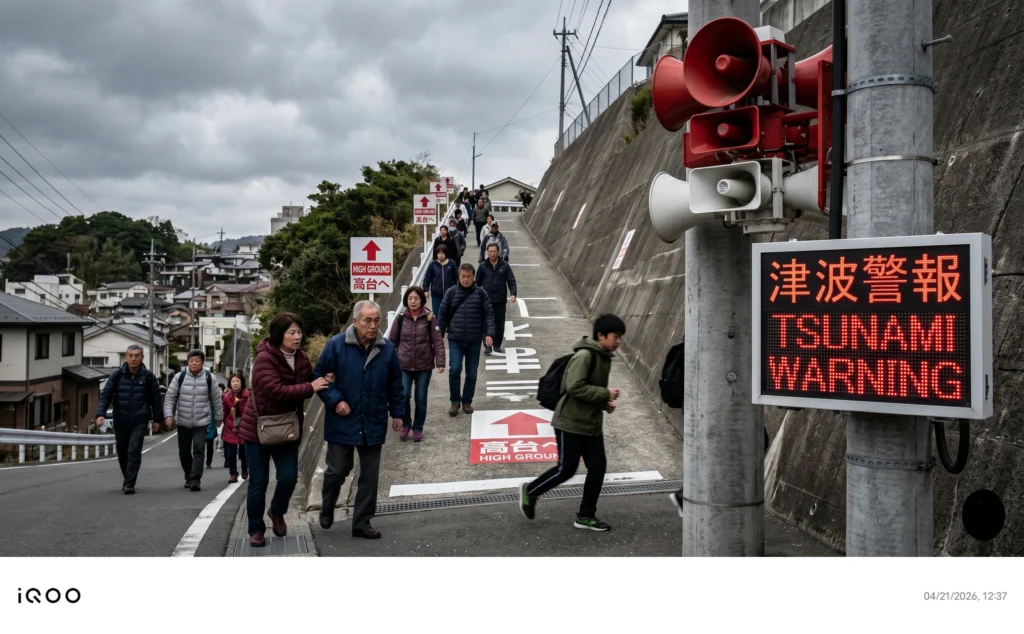
- 6:00 p.m.: Over 156,000 people were ordered to evacuate to higher ground across five prefectures.
While the waves did not reach the catastrophic heights initially feared, the psychological impact of the sirens and the sight of the receding tide brought back harrowing memories of the 2011 Great East Japan Earthquake.
The “Megaquake” Advisory: A Week of Uncertainty
What makes this April 2026 earthquake particularly significant is not just its magnitude, but the official response that followed. For only the second time since the system was established in 2022, the JMA issued a “Megaquake Subsequent Earthquake Advisory.”
This advisory warns that the probability of a Magnitude 8.0 or higher earthquake occurring within the next seven days has significantly increased. The JMA clarified that this is not a definite prediction of a disaster, but a statistical warning. The focus of this alert covers 182 municipalities, stretching from the northern tip of Hokkaido down to Chiba Prefecture near Tokyo.
Why is there a “Subsequent” Advisory?
Japan’s seismic experts have long studied the “Sanriku Trench” and the “Nankai Trough.” History shows that large quakes in these regions often occur in pairs or clusters. For example, the 2011 M9.0 quake was preceded by an M7.3 “foreshock” two days earlier. By issuing this advisory, the government is urging citizens to:
- Re-check emergency “go-bags.”
- Secure heavy furniture.
- Identify the nearest high-ground evacuation routes.
- Maintain a state of “normal life but heightened readiness.”
Current Status and Human Impact (As of April 21, 2026)
As of today, April 21, the immediate tsunami advisories have been lifted, but the nation remains in a state of suspended animation. The cleanup has begun, and the human toll is being tallied.
Injuries and Infrastructure
Fortunately, thanks to Japan’s world-leading building codes and early warning systems, the loss of life has been avoided so far.
- Injuries: Approximately 30 to 40 people have been reported injured, mostly from falls or being hit by falling objects. One man in Hachinohe, Aomori, was hospitalized after falling down stairs during the peak of the shaking.
- Transport: The Tohoku Shinkansen (bullet train) was immediately halted between Tokyo and Shin-Aomori. While services are beginning to resume today, significant delays persist as engineers inspect hundreds of kilometers of track for “buckling” or structural damage.
- Power: Small-scale outages affected roughly 200 households in Hiraizumi, Iwate, but most power was restored overnight.
- Nuclear Safety: In a move that always draws international attention, operators of the Onagawa, Higashidori, and the crippled Fukushima Daiichi plants reported no abnormalities. Cooling systems and containment structures remained stable throughout the event.
The Science: Why Sanriku?
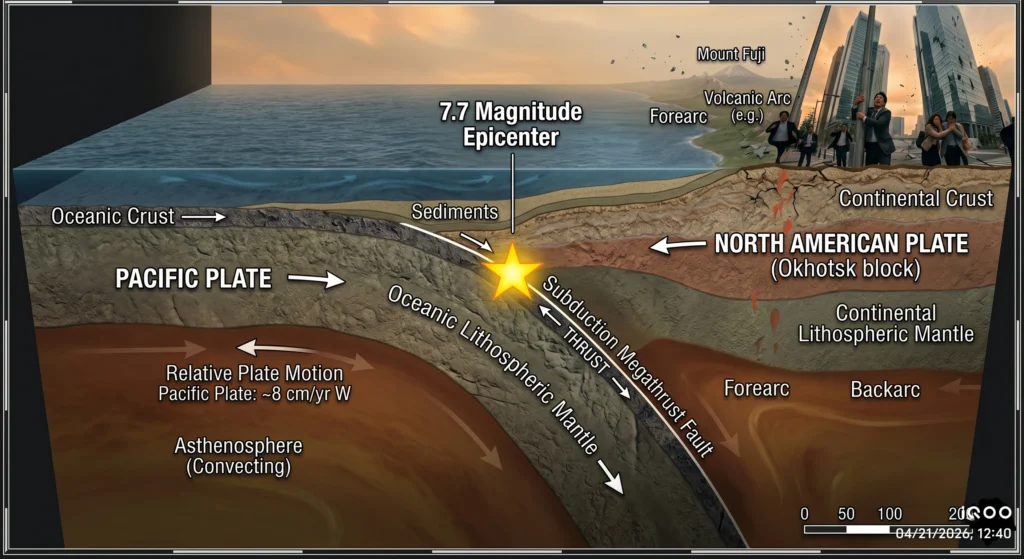
The Sanriku coast is arguably one of the most seismically dangerous places on Earth. It sits where the Pacific Plate is relentlessly sliding beneath the North American Plate (or the Okhotsk Microplate) at a rate of about 8 to 9 centimeters per year.
This subduction creates immense “elastic strain.” Think of it like a wooden ruler being bent slower and slower; eventually, the wood can’t take the tension and snaps. The April 20 event was a “thrust-faulting” quake—a direct result of that built-up tension being released.
The concern for the coming week is that this “snap” may have transferred stress to adjacent sections of the fault that are also “locked” and ready to break. This phenomenon, known as stress triggering, is why the next seven days are considered critical.
Living with the Shakes: The Human Element
To understand Japan today is to understand a culture of “seismic stoicism.” In the coastal towns of Tohoku, life hasn’t stopped, but it has shifted. Schools in Urakawa were closed today, not out of damage, but as a precaution while the megaquake advisory remains active.
Social media in Japan is currently a mix of technical data and community support. On platforms like X (formerly Twitter), Prime Minister Sanae Takaichi has been providing hourly updates, urging citizens to stay calm but prepared. Unlike the panic seen in other parts of the world, the Japanese response is methodical. Convenience stores remain stocked, and people go to work, though many now keep their running shoes near their desks and their phones fully charged at all times.
Summary Table: April 2026 Sanriku Event
| Feature | Details |
| Date & Time | April 20, 2026, at 4:53 p.m. JST |
| Magnitude | 7.7 $M_w$ (Revised from 7.4) |
| Epicenter | Off the Sanriku Coast (100km East of Miyako) |
| Depth | 19 km |
| Max Intensity | Upper 5 (Shindo Scale) |
| Max Tsunami | 80 cm (Kuji Port, Iwate) |
| Advisory Status | Megaquake Advisory Active (Next 7 Days) |
Looking Ahead: The Next 168 Hours
The world is watching Japan. The “Megaquake Advisory” is set to last for at least one week. If no major activity occurs by April 27, the alert level will likely be scaled back. However, the 2026 Sanriku Earthquake serves as a potent reminder that for this island nation, the threat of the “Big One” isn’t a matter of if, but when.
For now, the people of northern Japan are doing what they do best: cleaning up the broken glass, checking on their neighbors, and keeping one eye on the sea. The 7.7-magnitude jolt was a massive event in its own right, but in the grand, violent history of the Pacific Ring of Fire, it may yet be remembered as only the beginning of a much larger story.